Chicago Pulls Bond Offering -- Some History
Did President Gerald Ford provide a good example for today?

The City of Chicago just chose not to proceed with the sale of general obligation bonds in a larger bond offering planned for this week. An early news report framed that decision in terms of market conditions amidst upheaval in the Mideast. But the independently poor financial condition of the city is also in the mix.
Back in 2017, Kim Phillips-Fein wrote about a book about the near-bankruptcy of New York City in 1975. Titled Fear City, and subtitled New York’s Fiscal Crisis and the Rise of Austerity Politics, the book provides startlingly good historical perspective for what may soon develop into a new debate over how to resolve Chicago (and Illinois) government financial difficulties.
Fein opened her book with a discussion of early federal government resistance to extraordinary financial assistance for the city. Her argument appears framed in terms of warning about “austerity politics,” but I thought elements of her opening paragraphs were worth sharing for background for considering Chicago, Illinois and Washington D.C. choices framing City of Chicago finances today.

Introduction
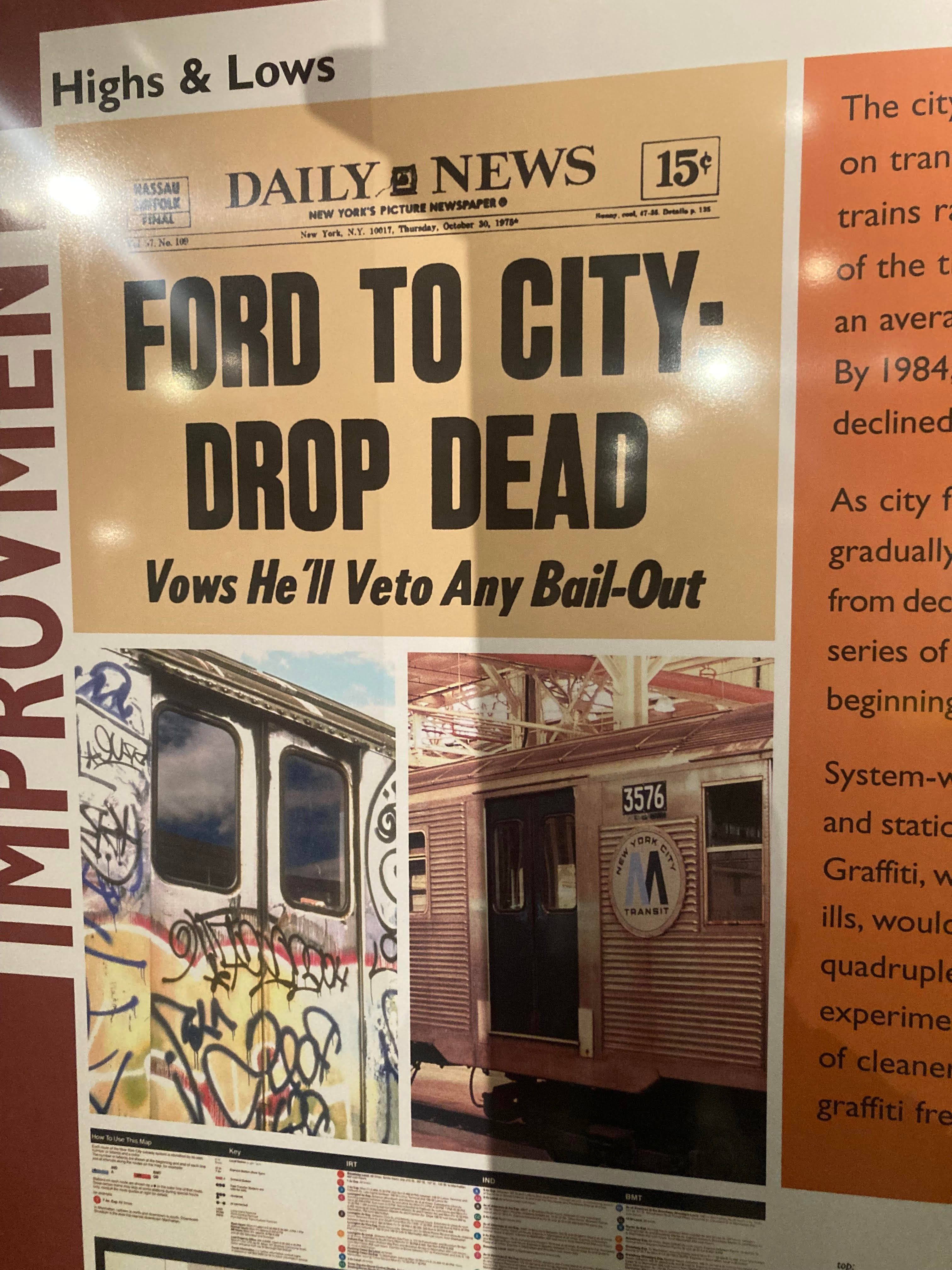
On October 30, 1975, the New York Daily News printed the most famous headline in its history: “Ford to City: Drop Dead.”
The previous day, President Gerald Ford had delivered a speech at the National Press Club in Washington on the looming bankruptcy of New York City. Once inconceivable, such a collapse fit with the climate of the time. … Massive corporate bankruptcies, near-bankruptcies, and financial collapses shook familiar business icons: the Penn Central railroad in 1970, the defense giant Lockheed in 1971, and the Long Island–based Franklin National Bank, the twentieth largest in the country, in 1974.
The prospect of New York City’s collapse seemed a further terrifying lurch. The leading men at the city’s biggest banks—including First National City Bank (the forerunner of Citibank), Morgan Guaranty, and Chase Manhattan—had spoken out in favor of federal aid for New York. Executives from around the country had traveled to Washington to testify that if the city went under, the fragile national economy might topple as well. … Lawmakers in Washington, Albany, and New York City itself eagerly awaited any hint that Ford might lend his support to a bailout deal. How would it look—what would it mean—for New York City, the country’s largest metropolis, the home of Wall Street, the heart of American finance, to wind up in bankruptcy court?
But President Ford and his closest advisers … strongly opposed federal help for New York. They were convinced that the city had brought its problems on itself through heedless, profligate spending. Bankruptcy was thus a just punishment for its sins, a necessary lesson in how the city should change to move forward. … Accordingly, Ford promised to veto the bills that were circulating through Congress to provide emergency aid to New York. Instead, he supported reforms to existing bankruptcy regulations that would make it easier for the city to file. The meaning was clear: New York could go bankrupt, and the federal government would do nothing to help.
… The harsh lesson was intended not only for New York. Ford believed that the United States had to face a new reality: the country—indeed, the world—had entered an era of slowed economic growth, an age of austerity, in which it was no longer possible for the government to pay for many social services to which the American people had grown accustomed. The citizens’ basic attitude toward government had to be transformed. Americans needed a revived philosophy of individual initiative centered on fiscal responsibility and limited spending. In the last few minutes of his talk, Ford scolded the nation: “If we go on spending more than we have, providing more benefits and more services than we can pay for, then a day of reckoning will come to Washington and the whole country just as it has to New York City. And when that day of reckoning comes, who will bail out the United States of America?” (emphasis added).